
6 min read ·
See the Fastest Belmont Stakes Times at 1½ Miles
See the 10 fastest Belmont Stakes times at 1½ miles, led by Secretariat’s 2:24.00, with exact gaps and shorter-distance results separated.
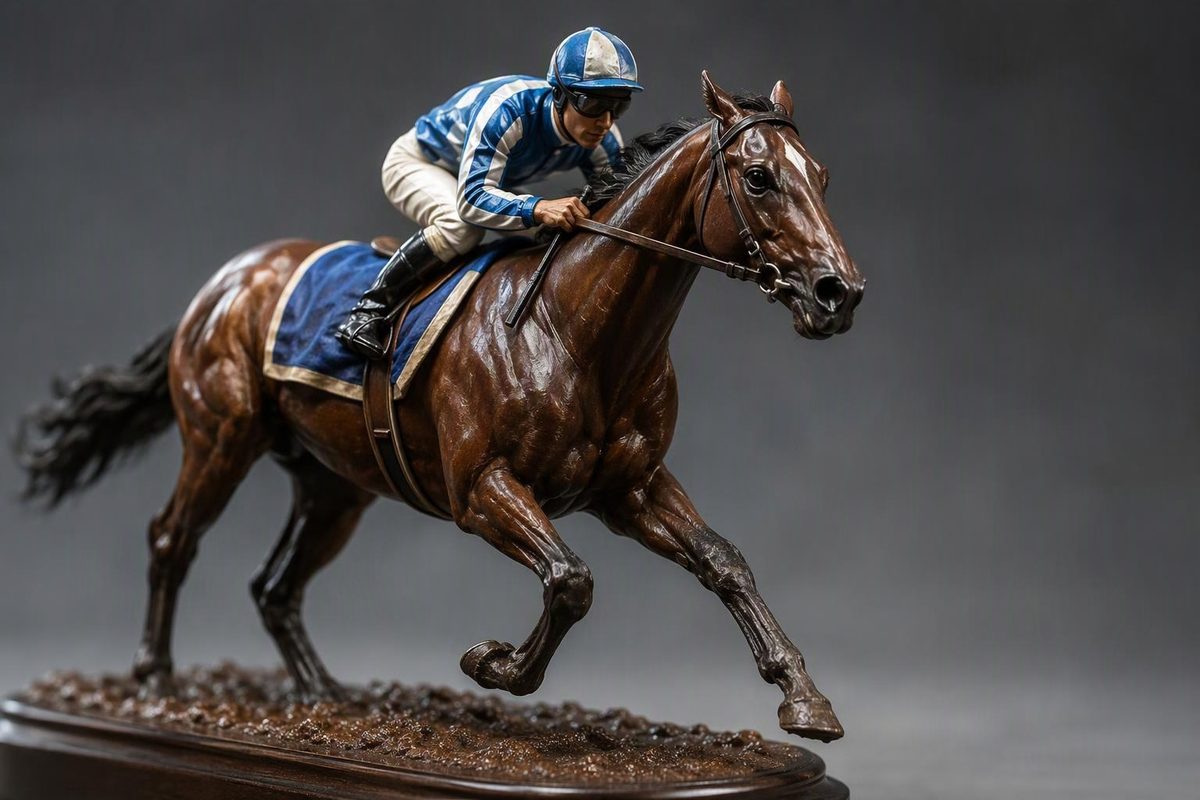
Secretariat holds the fastest Belmont Stakes time over the race’s traditional 1½-mile distance. His 2:24.00 in 1973 is two seconds faster than Easy Goer’s second-ranked 2:26.00, and no other winner through the 2026 running has broken 2:26.
The distance qualification is essential. The Belmont has not always been run over 1½ miles, so a list that sorts every winning time without first separating the distances gives the shortest editions an automatic advantage.
Choose two 1½-mile winners to calculate the exact difference between their times.
Compare the Fastest 1½-Mile Winners
Time difference
Secretariat was 2.00 seconds faster.
2:24.00 compared with Easy Goer’s 2:26.00.
| Rank | Winner | Year | Time |
|---|---|---|---|
| 1 | Secretariat | 1973 | 2:24.00 |
| 2 | Easy Goer | 1989 | 2:26.00 |
| 3 | A.P. Indy | 1992 | 2:26.13 |
| 4 | Risen Star | 1988 | 2:26.40 |
| 5 | Point Given | 2001 | 2:26.56 |
| 6 | Gallant Man | 1957 | 2:26.60 |
| 7 | American Pharoah | 2015 | 2:26.65 |
| 8 | Affirmed | 1978 | 2:26.80 |
| 9 | Tabasco Cat | 1994 | 2:26.82 |
| 10 | Creme Fraiche | 1985 | 2:27.00 |
Source: NYRA year-by-year Belmont Stakes winners, supplemented by the precise published times cited in the article.
Ten Fastest Belmont Stakes Times at 1½ Miles
Through the 2026 running, these are the ten fastest winning times over the traditional distance:
| Rank | Winner | Year | Winning time |
|---|---|---|---|
| 1 | Secretariat | 1973 | 2:24.00 |
| 2 | Easy Goer | 1989 | 2:26.00 |
| 3 | A.P. Indy | 1992 | 2:26.13 |
| 4 | Risen Star | 1988 | 2:26.40 |
| 5 | Point Given | 2001 | 2:26.56 |
| 6 | Gallant Man | 1957 | 2:26.60 |
| 7 | American Pharoah | 2015 | 2:26.65 |
| 8 | Affirmed | 1978 | 2:26.80 |
| 9 | Tabasco Cat | 1994 | 2:26.82 |
| 10 | Creme Fraiche | 1985 | 2:27.00 |
NYRA’s year-by-year winners archive provides the full result list. Daily Racing Form’s dedicated Belmont Stakes history and fastest-times table preserves the hundredths that separate A.P. Indy from Easy Goer and Tabasco Cat from Affirmed.
The National Museum of Racing also records Point Given’s 2:26.56 in its Hall of Fame profile. NYRA gives American Pharoah’s winning time as 2:26.65.
The ranking is tightly grouped after Secretariat. Easy Goer, A.P. Indy and Risen Star are separated by only 0.40 seconds. Point Given, Gallant Man and American Pharoah occupy a span of nine hundredths, while only two hundredths separate Affirmed and Tabasco Cat.
Creme Fraiche’s 2:27.00 is exactly three seconds slower than Secretariat’s record. It remains fast enough for tenth place, showing how little room there is at the bottom of this particular top ten: Tabasco Cat is only 0.18 seconds ahead of Creme Fraiche.
Hundredths Prevent False Ties
Some historical summaries display older times in fifths of a second or round performances to fewer decimal places. That is adequate for identifying the general minute-and-second range, but it can change the order of a fastest-times ranking.
Easy Goer’s 2:26.00 and A.P. Indy’s 2:26.13 can both appear as 2:26 in a table that omits fractions. They were not tied. Easy Goer completed the distance 0.13 seconds sooner.
The same issue appears farther down the list. Affirmed’s 2:26.80 is 0.02 seconds faster than Tabasco Cat’s 2:26.82. The official Equibase chart for the 1994 Belmont records Tabasco Cat’s result as 2:26.82, not simply 2:26.8.
Those hundredths should not be presented as more than they are. They establish the published order of the recorded times; they do not isolate the effect of pace, surface condition or any other race variable. But once the question is specifically about elapsed time, discarding available precision creates ties that the source data does not contain.
The conversion is straightforward: total seconds equal 60 times the minute figure, plus the remaining seconds. A.P. Indy’s 2:26.13 therefore becomes 146.13 seconds, while Easy Goer’s 2:26.00 becomes 146.00 seconds. Subtracting those totals gives the 0.13-second difference.
Secretariat Is Two Seconds Clear of Every Other Winner
Secretariat covered 1½ miles in exactly 144 seconds. Easy Goer took 146 seconds, making the gap between first and second exactly 2.00 seconds.
That separation is much larger than the gaps immediately below it. Only 0.60 seconds separates Easy Goer in second from Gallant Man in sixth. In other words, five places in the ranking fit inside less than one-third of Secretariat’s advantage over the runner in second.
The record holder’s lead over each top-ten winner is:
| Winner | Time | Gap to Secretariat |
|---|---|---|
| Easy Goer | 2:26.00 | 2.00 sec |
| A.P. Indy | 2:26.13 | 2.13 sec |
| Risen Star | 2:26.40 | 2.40 sec |
| Point Given | 2:26.56 | 2.56 sec |
| Gallant Man | 2:26.60 | 2.60 sec |
| American Pharoah | 2:26.65 | 2.65 sec |
| Affirmed | 2:26.80 | 2.80 sec |
| Tabasco Cat | 2:26.82 | 2.82 sec |
| Creme Fraiche | 2:27.00 | 3.00 sec |
Secretariat’s average speed over the full trip was 37.5 mph. The calculation divides 1.5 miles by 144 seconds expressed as a fraction of an hour. Easy Goer averaged just under 37.0 mph over his 146-second performance.
These are whole-race averages, not measurements of the horses’ speed at every point. A horse can run faster or slower during individual sections while finishing with the same total elapsed time. The average is useful for expressing the difference on a common scale, but the official finishing time remains the basis of the ranking.
NYRA says Secretariat’s 2:24 established the world record for 1½ miles on dirt. He also won the 1973 Belmont by 31 lengths, according to NYRA’s Belmont history.
The two figures describe different things. The 2:24 measures how long Secretariat took to cover the course; the 31 lengths measure his winning margin over the next finisher. Margin should not be added to or otherwise folded into a fastest-time ranking.
Shorter Belmont Editions Require Separate Lists
A race time has meaning only when paired with its distance. NYRA’s historical account shows that the Belmont has been staged over distances ranging from 1⅛ miles to 1⅝ miles. The event settled at 1½ miles in 1926, but not every subsequent running has used that trip.
The pandemic-affected 2020 edition was shortened to 1⅛ miles. Tiz the Law won in 1:46.53. That is the smallest raw winning-time number on the modern list, but he ran three furlongs less than Secretariat. His 1:46.53 therefore cannot replace 2:24.00 as the fastest time over 1½ miles.
Belmont Park’s reconstruction led to the race moving to Saratoga and being run over 1¼ miles in 2024. NYRA describes the distance change in its account of the Belmont’s changing conditions, and the official 2026 stakes schedule retained the 1¼-mile distance.
Among the 2024–2026 Saratoga editions in the relevant set, Sovereignty’s 2:00.69 in 2025 is the fastest winning time. It belongs in a 1¼-mile comparison, not in the traditional 1½-mile table.
The fastest winners in the relevant distance sets are:
| Distance | Winner | Year | Time |
|---|---|---|---|
| 1⅛ miles | Tiz the Law | 2020 | 1:46.53 |
| 1¼ miles at Saratoga | Sovereignty | 2025 | 2:00.69 |
| 1½ miles | Secretariat | 1973 | 2:24.00 |
These figures come from NYRA’s year-by-year winners table. The table does not claim that one of these three performances was intrinsically better than the others. It identifies the lowest winning time within each stated distance category.
Comparing 1:46.53, 2:00.69 and 2:24.00 as if all three horses covered the same ground would mainly reveal that shorter races take less time. Normalizing them into average speeds can provide another descriptive view, but that still does not reproduce the pace, conditions or demands of a race over a different distance.
Winning Time Is Not a Complete Performance Rating
Winning time is the elapsed period from the start to the finish. It is recorded form, but it is not a complete performance rating.
Pace can change how a race develops before the field reaches the finish. Track condition and the speed of the racing surface can also affect the clock. A speed figure attempts to adjust for factors that raw elapsed time leaves untreated, although methods differ between providers.
The fastest-times table therefore answers a narrow question: which Belmont winners completed the same 1½-mile distance fastest? On that measure, Secretariat is first, Easy Goer is second and A.P. Indy is third.
The table does not independently establish that these were the ten best Belmont performances under every possible definition. It also cannot show how the horses would compare if they met under identical conditions. The historical races occurred in different years and produced recorded times under the circumstances of each running.
The distinction also matters when reading a racecard. A raw time reports what happened over a stated trip. A rating is an interpretation intended to make performances more comparable. Treating the two as interchangeable removes the adjustments that make a rating a separate measure in the first place.
For the broader distinction, see how speed-figure providers differ from raw times.