
8 min read ·
How Secretariat Won the Belmont by 31 Lengths
Explore Secretariat’s 1973 Belmont result, quarter-mile splits and race conditions, with a pace tool showing what his 2:24 time and 31-length margin mean.
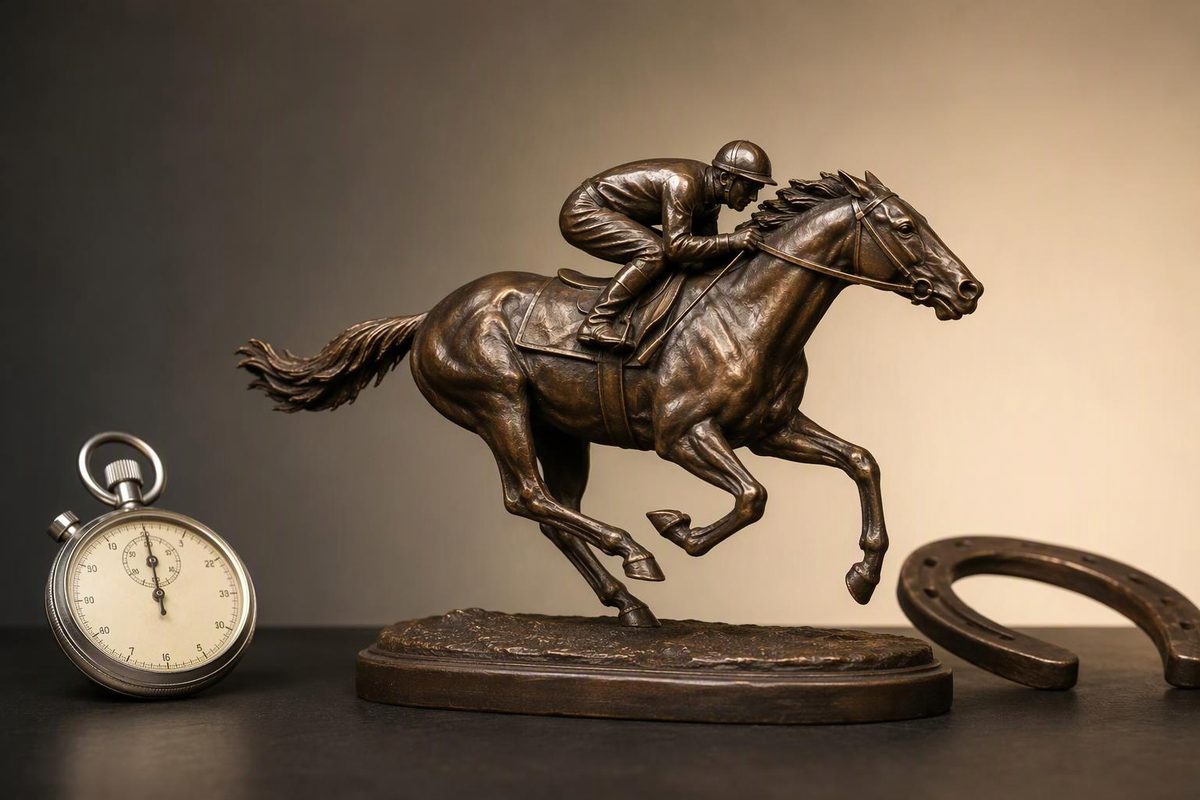
Secretariat won the Belmont Stakes on June 9, 1973, by 31 lengths in 2 minutes 24 seconds over 1½ miles. Ridden by Ron Turcotte and trained by Lucien Laurin for Meadow Stable, he became the ninth American Triple Crown winner—and the first since Citation in 1948. The New York Racing Association’s account records both the winning time and the margin over runner-up Twice a Prince.
Those two famous numbers measure different things: 2:24 is elapsed race time; 31 lengths is the winning margin. Neither is a speed rating. The quarter-mile splits explain how Secretariat produced the time: a contested, exceptionally quick opening followed by progressively slower quarters, even as his advantage widened.
Choose a quarter-mile section to see its split and the cumulative times that produce it.
Quarter-Mile Split Reader
Split = cumulative time at the end minus cumulative time at the start.
46.2 sec − 23.6 sec = 22.6 sec.
Fastest recorded quarter. The final quarter took 25.0 sec.
Sources: Secretariat archive and NYRA. Splits are calculated from recorded cumulative fractions; decimal notation represents historical fifths of a second.
The Result Was Over 12 Furlongs On Fast Dirt
The 105th Belmont Stakes took place at Belmont Park over 1½ miles, or 12 furlongs, on a dirt track officially described as fast. Secretariat carried 126 lb, the same assigned weight as the other four starters. The race conditions prescribed weights rather than allocating different loads through handicap ratings. These details appear in the 1973 race chart retained by NYRA.
| Race Detail | Recorded Value |
|---|---|
| Course | Belmont Park |
| Distance | 1½ miles / 12 furlongs |
| Surface and condition | Dirt, fast |
| Secretariat’s weight | 126 lb |
| Winning time | 2:24.0 |
| Winning margin | 31 lengths |
The finishing order was Secretariat, Twice a Prince, My Gallant, Pvt. Smiles and Sham. Twice a Prince beat My Gallant by half a length for second; Sham, who had finished second to Secretariat in both the Kentucky Derby and Preakness, finished last. BloodHorse’s retrospective confirms the order and recounts the race through the rival jockeys’ recollections.
That finishing order fixes the reference point for the famous margin. Secretariat’s 31 lengths were measured over Twice a Prince, the horse who finished second. They were not his margin over Sham, despite Sham’s role in the early pace and their rivalry through the preceding Triple Crown races.
The equal assigned weights also matter when reading the result. Secretariat did not receive a lighter load than the other starters. But 126 lb is a carried weight, not an assessment of ability: it should not be read as an official rating or treated as evidence that all five runners had equal chances.
The 31-Length Margin Is Not A Time Gap
A length represents approximately one horse’s body length. It is a racing margin, not a fixed number of seconds. Secretariat’s 31-length margin therefore describes his separation from Twice a Prince, not a 31-second advantage. The Secretariat archive explains the distinction between the estimated gaps called during the race and the final recorded margin.
The distinction is especially useful when watching the replay. An estimate of Secretariat’s lead during the running describes the gap at that point. The final margin describes the result at the finish. Those observations concern different moments and need not match.
Nor should the winning time be used as the runner-up’s time. The recorded 2:24 belongs to Secretariat’s winning performance. The supplied accounts do not provide an independently timed finishing figure for Twice a Prince, so there is no supported runner-up time to report here.
Subtracting an assumed number of seconds per length would create a converted estimate, not recover a measured time. Without a stated conversion method and its assumptions, that would make the result look more precise than the evidence permits. Keep the margin in lengths and the winning time in minutes and seconds.
A large margin and a fast time are also separate pieces of evidence. The margin tells you how decisively a horse beat that field; the clock tells you how long the winner took over that distance under those conditions. Secretariat’s Belmont has both an extraordinary separation and a record time, but neither number is a substitute for the other.
The Fractions Show A Fast Opening, Not Constant Acceleration
A fractional time is cumulative: it measures elapsed time from the start to a particular distance. A split measures only the section between two timing points. Confusing them can turn an accurate race chart into an inaccurate account of the pace.
The recorded fractions below come from the Secretariat archive’s race account and NYRA’s account. The quarter-mile splits are calculated by subtraction. Historical fifths of a second are expressed here as decimals: 23⅗ seconds becomes 23.6 seconds. The decimal presentation changes the notation, not the underlying timing precision.
| Distance Reached | Cumulative Time | Latest Quarter Split |
|---|---|---|
| ¼ mile | 0:23.6 | 23.6 sec |
| ½ mile | 0:46.2 | 22.6 sec |
| ¾ mile | 1:09.8 | 23.6 sec |
| 1 mile | 1:34.2 | 24.4 sec |
| 1¼ miles | 1:59.0 | 24.8 sec |
| 1½ miles—finish | 2:24.0 | 25.0 sec |
For example, the second quarter-mile split is 46.2 seconds minus 23.6 seconds, which equals 22.6 seconds. The 46.2 figure is the time for the opening half-mile, not for the second quarter alone. The same subtraction applies to each later section after converting the cumulative times to seconds.
Secretariat and Sham contested the early lead. After three-quarters of a mile, Secretariat drew away; the chart describes him as drawing off at will around the far turn under a hand ride from Turcotte. That race development matters alongside the clock: he established the record after a contested opening, not after an uncontested slow start.
The splits correct a common misreading: Secretariat did not run every successive quarter faster. His fastest quarter was the second, at 22.6 seconds; his final quarter took 25.0. After the second quarter, each successive quarter took longer than the one before it.
The opening six furlongs took 69.8 seconds and the closing six took 74.2. Those are equal-distance sections, so their elapsed times can be compared directly within this race. They show that the second half took longer than the first, even though Secretariat’s lead became much larger.
A Widening Lead Does Not Mean Increasing Speed
The visual impression of Secretariat pulling away is consistent with the splits. A horse can cover successive sections more slowly and still increase its lead if the horses behind lose ground relative to it. Separation measures the relationship between competitors; a split measures elapsed time over a defined section.
That is the central distinction in this Belmont. Secretariat’s advantage grew while his quarter-mile times lengthened. There is no contradiction: his rivals were not maintaining his pace. The winning margin reflects that relative difference, not a requirement that he accelerate all the way to the finish.
The supplied fractions do not establish individual quarter-mile splits for every beaten horse. They therefore cannot quantify exactly how much each rival slowed in each section. The finishing order, the chart’s running commentary and Secretariat’s recorded times support the broad account without supplying a complete sectional record for the field.
Quarter-mile splits also describe sections, not every instant within them. A slower final quarter does not prove that Secretariat’s speed decreased continuously throughout that quarter. He could change speed within a section; the reported split gives only its total elapsed time. Claims about moment-by-moment acceleration would require more detailed evidence than these fractions provide.
For a racecard reader, this is why a comment such as “drew clear” should be read alongside the pace rather than translated automatically into “ran faster.” The comment describes the changing race position. The clock is needed to establish whether a measured section was faster or slower.
The 2:24 Was A Track Record, Not A Rating
The 2:24 established a new Belmont Park track record at the distance, as recorded in the official chart. That is a specific claim about the course and trip. For comparisons with other editions, use the same distance: our fastest Belmont Stakes times at 1½ miles keeps shorter-distance runnings separate.
A race title alone does not make times comparable. A shorter-distance running of the Belmont Stakes answers a different timing question from a 12-furlong running. Sorting both together by elapsed time would favor the shorter journey rather than identify the fastest performance over the same trip.
Even a same-distance comparison needs its conditions attached. Here, the recorded surface condition was fast dirt. That tells you how the track was officially described, but it is not a numerical adjustment for how the surface influenced the time. The supplied evidence does not include a track variant with which to convert the performance into a conditions-adjusted figure.
Similarly, the raw winning time is not a speed rating. A rating requires a defined method for interpreting performances; simply writing 2:24 beside the result does not perform that calculation. The supplied sources do not give a speed-rating figure to report, and the 31-length margin cannot stand in for one.
The distinction does not diminish the performance. It keeps the claims exact: Secretariat won decisively, completed the recorded distance in the recorded time, and set a Belmont Park record at that distance. A separate assertion about a rating or an adjusted comparison needs separate evidence.
Read The Belmont Form Line In Layers
Secretariat’s finishing position gives the result, but it does not explain how the result happened. First place alone leaves out the winning margin, the time and the pace contest with Sham. Adding those details turns a bare placing into a much more informative performance record.
The next layer is the race setup: 12 furlongs, fast dirt and 126 lb under prescribed weight conditions. Those details define the task Secretariat completed. They also prevent the carried weight from being mistaken for an ability rating or the time from being compared indiscriminately with a different-distance race.
Then read the fractions. The 22.6-second second quarter identifies the quickest measured quarter; the 25.0-second final quarter shows that the finish was slower over an equal distance. The opening and closing six-furlong times make the same distinction over larger sections. Together, they explain why “he kept getting faster” is not an accurate description of the recorded pace.
Finally, attach the running commentary and margin. The contested opening, the move away after three-quarters of a mile and the 31-length finish explain the competitive shape of the race. They add information that the total time alone cannot supply, while the splits constrain what can reasonably be claimed from the replay.
The precise reading is therefore stronger than the shorthand: Secretariat ran 1½ miles in 2:24 on fast dirt, beat Twice a Prince by 31 lengths, and widened his lead despite slower later quarters. Those are complementary facts about time, conditions and competition—not interchangeable measures of speed.