
19 min read ·
A Practical Guide to Horse Height, From Ponies to Draft Breeds
Many adult riding horses stand 14.2–17 hands (4 ft 10 in–5 ft 8 in). Compare ponies and draft horses, convert units and measure at the withers.
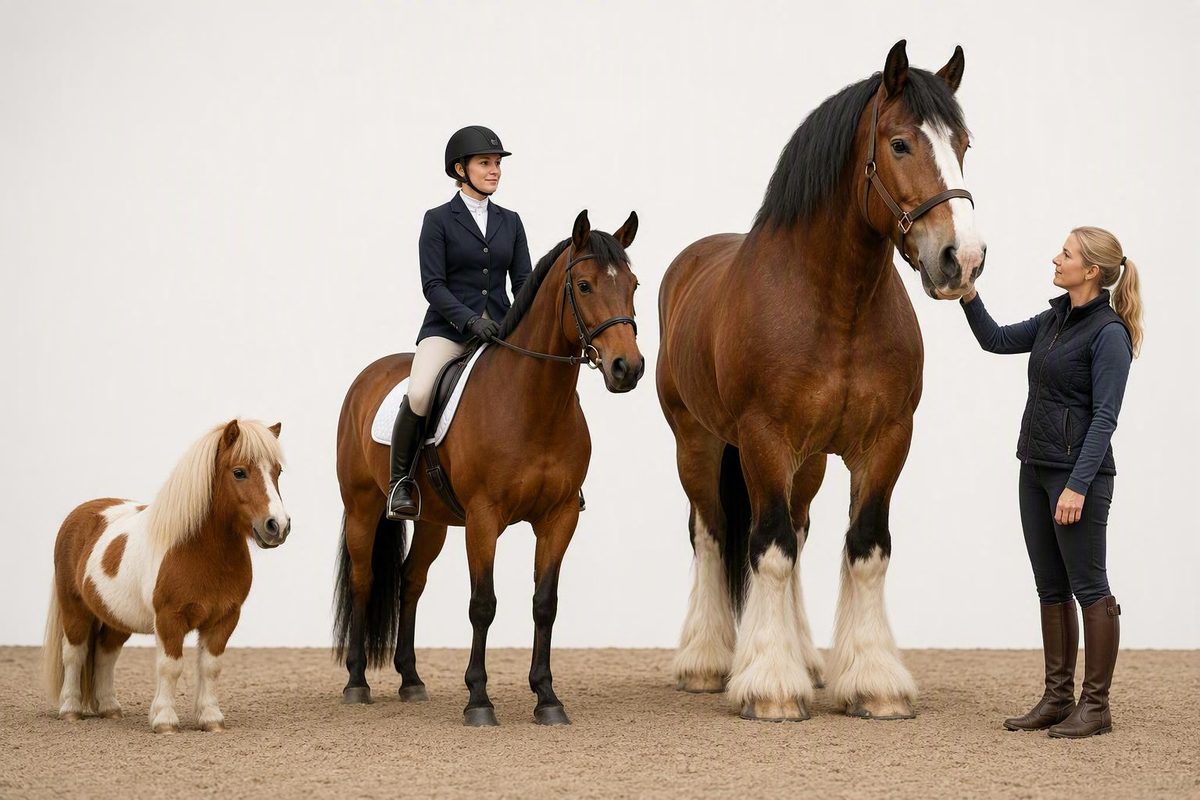
Many adult riding horses stand between 14.2 and 17 hands high, but horses vary much more widely when Miniature Horses, pony breeds and draft horses are included. This guide explains the range, the notation and the correct way to measure a horse.
Editorial scope: This article provides general educational information. It is not veterinary, nutritional, tack-fitting, breed-registry or competition advice. Conversions have been independently checked against the standard four-inch hand.
Related: How to Read a Racecard.
The short answer: a practical horse-height range
Many adult riding horses stand about 14.2 to 17 hands high (hh). That equals:
- 58–68 inches
- 4 ft 10 in–5 ft 8 in
- approximately 147–173 cm
- approximately 1.47–1.73 metres
This is a practical riding-horse range, not a universal average. Published category ranges place light riding horses around 14–16 hands, larger riding horses around 15.2–17 hands, and heavy or draft horses around 16–18 hands (Horse & Country’s horse-height guide).
Miniature Horses and small ponies can be much shorter than 14.2 hands, while large draft horses can be taller than 17 hands. The answer therefore changes according to which animals are included.
There is no defensible single average for every horse population in the evidence used here. Figures such as 15 or 16 hands are sometimes presented as universal averages, but they are not supported by a defined all-horse dataset. The frequently quoted 13.3–17.3-hand figure is better understood as a broad range reported across breeds, not a calculated statistical mean (Horse Illustrated’s overview of horse heights).
That distinction matters because a “typical” height depends on the population being described. A group of Miniature Horses will not resemble a group of Thoroughbreds, warmbloods or draft horses. For estimating the likely height of an individual, breed or type is usually more informative than a single all-horse figure.
A concise answer to “How tall are horses?” is therefore:
Many adult riding horses are roughly 14.2–17 hands, or 4 ft 10 in–5 ft 8 in at the withers, but breed and type create a much wider overall range.
Height describes only the vertical distance from the ground to the withers. It does not tell you how high the ears are, how long the horse is or how heavily built it may be.
What hands high means—and why 15.2 is not a decimal
A hand is the traditional unit used to state horse height. One hand equals exactly 4 inches, or 10.16 centimetres. The abbreviations h and hh are both used, with “hh” meaning “hands high.”
Hand notation resembles a decimal, but it does not work like one. In 15.2 hh:
- 15 means 15 complete hands;
- 2 means 2 additional inches;
- the point separates the complete hands from the remaining inches.
Because each hand contains four inches, the conventional endings are:
- .0 = no extra inches
- .1 = 1 extra inch
- .2 = 2 extra inches
- .3 = 3 extra inches
The withers measurement and four-inch unit are described by the American Museum of Natural History’s guide to measuring horses.
There is no conventional .4 ending. Four additional inches make another full hand, so 15.4 hh carries into the next hand and is written 16.0 hh, or simply 16 hh.
Converting hands into inches
Use this formula:
Total inches = (whole hands × 4) + final inch digit
For example:
14.2 hh
- 14 × 4 = 56 inches
- 56 + 2 = 58 inches
- 58 inches = 4 ft 10 in
- 58 inches = 147.32 cm
Therefore:
14.2 hh = 58 inches = 4 ft 10 in = about 147.3 cm
15.2 hh
- 15 × 4 = 60 inches
- 60 + 2 = 62 inches
- 62 inches = 5 ft 2 in
- 62 inches = 157.48 cm
Therefore:
15.2 hh = 62 inches = 5 ft 2 in = about 157.5 cm
16.3 hh
- 16 × 4 = 64 inches
- 64 + 3 = 67 inches
- 67 inches = 5 ft 7 in
- 67 inches = 170.18 cm
Therefore:
16.3 hh = 67 inches = 5 ft 7 in = about 170.2 cm
Converting inches into hands
To reverse the calculation:
- Divide the total number of inches by 4.
- The whole-number quotient gives the complete hands.
- The remainder becomes the digit after the point.
For example, divide 67 inches by 4:
- 4 goes into 67 sixteen times;
- the remainder is 3;
- the height is therefore 16.3 hh.
The notation is best understood as complete groups of four inches plus a remainder, not as an ordinary decimal.
Horse-height conversion chart
The chart below has been independently calculated using 1 hand = 4 inches and 1 inch = 2.54 cm. Centimetre figures are rounded to one decimal place. Quarter-hand increments equal one inch, and four such increments carry into the next complete hand (Horse Network’s explanation of hand measurements).
| Hands | Total inches | Feet and inches | Centimetres |
|---|---|---|---|
| 12.0 hh | 48 | 4 ft 0 in | 121.9 cm |
| 12.1 hh | 49 | 4 ft 1 in | 124.5 cm |
| 12.2 hh | 50 | 4 ft 2 in | 127.0 cm |
| 12.3 hh | 51 | 4 ft 3 in | 129.5 cm |
| 13.0 hh | 52 | 4 ft 4 in | 132.1 cm |
| 13.1 hh | 53 | 4 ft 5 in | 134.6 cm |
| 13.2 hh | 54 | 4 ft 6 in | 137.2 cm |
| 13.3 hh | 55 | 4 ft 7 in | 139.7 cm |
| 14.0 hh | 56 | 4 ft 8 in | 142.2 cm |
| 14.1 hh | 57 | 4 ft 9 in | 144.8 cm |
| 14.2 hh | 58 | 4 ft 10 in | 147.3 cm |
| 14.3 hh | 59 | 4 ft 11 in | 149.9 cm |
| 15.0 hh | 60 | 5 ft 0 in | 152.4 cm |
| 15.1 hh | 61 | 5 ft 1 in | 154.9 cm |
| 15.2 hh | 62 | 5 ft 2 in | 157.5 cm |
| 15.3 hh | 63 | 5 ft 3 in | 160.0 cm |
| 16.0 hh | 64 | 5 ft 4 in | 162.6 cm |
| 16.1 hh | 65 | 5 ft 5 in | 165.1 cm |
| 16.2 hh | 66 | 5 ft 6 in | 167.6 cm |
| 16.3 hh | 67 | 5 ft 7 in | 170.2 cm |
| 17.0 hh | 68 | 5 ft 8 in | 172.7 cm |
| 17.1 hh | 69 | 5 ft 9 in | 175.3 cm |
| 17.2 hh | 70 | 5 ft 10 in | 177.8 cm |
| 17.3 hh | 71 | 5 ft 11 in | 180.3 cm |
| 18.0 hh | 72 | 6 ft 0 in | 182.9 cm |
The apparent jump from 12.3 to 13.0, or from 17.3 to 18.0, does not indicate a missing measurement. It is the point at which the fourth additional inch becomes another complete hand.
Where horse height is measured
A horse’s standard height is the vertical distance from the ground to the highest point of the withers. The withers are the highest point of the back and are formed by vertebrae between the shoulder blades.
The measurement does not continue to the top of the head or ears. A horse described as 16 hands is 64 inches at the withers, not 64 inches to the top of its head.
The withers provide a practical anatomical reference because a horse can raise, lower or turn its head, changing the position of its poll and ears. The top of the withers varies less with ordinary head and neck movement, making it a more consistent reference point.
It is also important not to use shoulder as a substitute for withers. Although the withers lie between the shoulder blades, horse height is measured to the highest point of the withers—not to an arbitrary point on the shoulder.
A labeled illustration should show:
- a level ground line beneath the horse;
- a rigid measuring stick standing vertically;
- a horizontal crossbar meeting the horse;
- the highest point of the withers;
- the measurement running vertically rather than along the body.
Recommended alt text: “Side view of a horse standing on level ground, with a vertical height stick and horizontal crossbar positioned at the highest point of the withers.”
That visual distinction helps prevent two common errors: measuring to the head and running a flexible tape along the horse’s contour.
How to measure a horse accurately at home
A basic home measurement is straightforward, but surface, stance and tool position can all affect the result. If accuracy matters, control those variables rather than attempting to correct a poor reading afterward.
1. Choose a firm, level surface
Place the horse on smooth, hard and level ground. Concrete, asphalt or another stable surface is preferable to deep bedding, rutted soil, long grass or a slope.
Uneven or compressible footing can change the horse’s stance and distort the vertical relationship between the ground and the withers.
2. Stand the horse square and relaxed
Ask the horse to stand naturally with its weight distributed evenly over all four feet. Its legs should not be stretched markedly forward or backward, and it should not be leaning away from the handler.
Allow the head and neck to remain in a relaxed, natural position. Do not attempt to make the horse appear taller by raising its head.
3. Find the highest point of the withers
Identify the top of the withers before positioning the measuring tool. This is the highest point of the ridge between the shoulder blades—not the base of the neck or the nearest convenient point on the back.
Finding the reference point first makes it easier to position the crossbar without repeatedly moving the equipment against the horse.
4. Prefer a rigid measuring stick
A purpose-made height stick normally has:
- a rigid vertical shaft;
- clear height markings;
- a horizontal arm or crossbar;
- ideally, a means of checking that the shaft is vertical and the arm is level.
A tape measure, marked string or twine can provide an estimate, but flexible tools are easier to angle or curve. When accuracy matters, a rigid stick with a horizontal arm is preferable.
5. Keep the stick vertical
Place the stick beside the horse and perpendicular to the ground. Lower the horizontal arm until it meets the highest point of the withers.
Do not lean the stick toward the horse, tilt the crossbar or measure over the curve of the body. Horse height is a vertical measurement, not the surface distance from hoof to withers.
6. Repeat the measurement
For greater consistency, measure once from each side and calculate the average. The archived Iowa State University Extension procedure recommends this two-reading method and specifies a square, relaxed stance on a smooth, level surface (Iowa State University Extension’s measurement procedure).
7. Avoid poor measuring conditions
Do not measure while the horse is:
- stretched out;
- shifting its weight;
- resisting the handler;
- standing on a slope or soft, irregular footing;
- recovering immediately after strenuous work.
The objective is a calm and repeatable stance, not the largest or smallest possible reading.
8. Check the applicable official rules
If the measurement is required for a competition, class, breed registry or formal certificate, consult that organization’s current rules.
There is no universal horseshoe allowance that applies to every organization. For example, the archived Iowa procedure directs officials to deduct one-quarter inch when an animal is wearing shoes, while other competition rules may use a different procedure or require measurement without shoes. General measuring guidance also advises competitors to confirm the applicable shoe rule rather than assume one (Horse.com’s guide to measuring horse height).
Quick measurement checklist
- Surface: smooth, firm and level
- Stance: square, relaxed and evenly weighted
- Reference point: highest point of the withers
- Tool: preferably a rigid vertical stick with a horizontal arm
- Position: stick perpendicular to the ground; crossbar level
- Reading: measure vertically, not along the body
- Repeat: take one reading from each side and average them
- Record: note hands, inches or centimetres clearly
- Official use: check the relevant organization’s current rules
Horse-height chart by type and breed
Breed tables are useful for orientation, but they should not be read as hard limits. The figures below are typical reported ranges, not guarantees for every individual. The hand ranges come from a published equestrian breed comparison; the inch and centimetre figures have been independently recalculated to avoid carrying over inconsistent source conversions (Horse Illustrated’s breed-height comparison).
| Category | Example breed or type | Typical reported range | Inches | Centimetres |
|---|---|---|---|---|
| Miniature Horses and small ponies | Miniature Horse | 7.0–9.2 hh | 28–38 in | 71.1–96.5 cm |
| Pony breeds | Shetland Pony | 7.0–11.2 hh | 28–46 in | 71.1–116.8 cm |
| Light or general riding horses | Arabian | 14.2–15.3 hh | 58–63 in | 147.3–160.0 cm |
| Light or general riding horses | American Paint Horse | 14.3–16.2 hh | 59–66 in | 149.9–167.6 cm |
| Light or general riding horses | American Quarter Horse | 14.3–16.2 hh | 59–66 in | 149.9–167.6 cm |
| Larger riding, racing and sport horses | Thoroughbred | 15.2–17.0 hh | 62–68 in | 157.5–172.7 cm |
| Larger riding and sport horses | Dutch Warmblood | 15.2–17.0 hh | 62–68 in | 157.5–172.7 cm |
| Draft horses | Clydesdale | 16.0–18.0 hh | 64–72 in | 162.6–182.9 cm |
Miniature Horses and small ponies
Miniature Horses occupy the lowest part of this comparison, with a reported range of about 7 to 9.2 hands. Despite that height, they are called Miniature Horses rather than simply being relabeled as ponies.
The distinction shows why terminology depends on breed identity and type as well as height. It is not safe to assume that every small equine belongs to a pony breed.
Pony breeds
Shetland Ponies are reported across a relatively broad 7 to 11.2-hand range. A Shetland may therefore overlap in height with a Miniature Horse while remaining distinct in breed identity and type.
“Pony” can refer to a recognized breed, a physical type or a competition classification. Those uses do not always produce the same answer.
Light or general riding horses
Arabians, American Paint Horses and American Quarter Horses provide useful examples from the middle of the height spectrum. Their reported ranges overlap substantially even though the breeds can differ in build, proportions and typical use.
A measurement such as 15.1 hh therefore does not identify a breed. It establishes only the horse’s height at the withers.
Larger riding, racing and sport horses
Thoroughbreds are a particularly relevant example for racing newcomers. Their typical reported range here is 15.2 to 17 hands, the same reported span as Dutch Warmbloods in this comparison.
That overlap does not make the breeds physically equivalent. Nor does a Thoroughbred’s position within the range reveal its class, speed, fitness or likely performance. Height is one physical measurement, not a rating.
Draft horses
Clydesdales illustrate the upper end of the representative table at around 16 to 18 hands. However, “draft horse” should not be reduced to a height cutoff.
A fine-boned riding horse and a heavily built draft horse can share the same withers height while looking markedly different. Ancestry, proportions, bone, musculature and the purpose for which a breed was developed all contribute to type.
Across every category, an individual may stand below or above the listed range. A breed range describes a general population tendency; it is not a rule that every member must satisfy.
Horse or pony? Why 14.2 hands is not an absolute rule
A commonly used dividing line between horses and ponies is 14.2 hands:
- 14 hands = 56 inches
- plus 2 inches = 58 inches
- 58 inches = 4 ft 10 in
- 58 inches = approximately 147.3 cm
Under this convention, equines below 14.2 hands are often grouped as ponies, while those at or above it are often grouped as horses. But this is a classification convention, not a universal definition that overrides every breed or organization.
Breed identity and physical type can produce exceptions. A named horse breed does not necessarily become a pony breed because an individual is short. Likewise, a pony breed’s identity is not determined solely by whether an individual falls on one side of a competition threshold.
Registry standards and competition classes can also serve different purposes. A registry may consider ancestry and breed characteristics, while an event organizer may use a height boundary to divide classes. Readers should therefore avoid treating one familiar threshold as a universal rule.
The archived Iowa 4-H procedure demonstrates the problem, but it must be read cautiously. It says horses are 14.1 hands and over and ponies are under 14.1 hands. The archived Iowa page labels its horse threshold as 14.1 hands (56 inches) Measurement Procedure for Horses and Ponies | Iowa State University Extension and Outreach Equine Science. The archived page therefore confirms that organization-specific wording must be checked, but it should not be used as a clean universal conversion or current rule.
They occupy pony-sized heights while retaining the name and identity of Miniature Horses.
The practical conclusion is simple: 14.2 hands is a useful rule of thumb, not an absolute answer. If classification affects eligibility, entry or an official certificate, use the current rules of the responsible organization.
Why horses vary so much in height
Horse height varies because mature stature reflects several interacting influences rather than one universal template.
Genetics and breed
Genetics and selective breeding are major contributors to mature height. Breed populations show recognizable tendencies, including small pony breeds, lighter riding horses, taller sport types and large draft breeds. Published overviews likewise identify genetics and breed as important influences on horse size (Horse & Country’s discussion of horse size).
Selective breeding does not make every member of a breed identical. This is one reason breed ranges overlap and why an individual may fall outside the range commonly reported for its breed.
Nutrition, health and development
Nutrition and development can influence growth, but the available evidence does not support a universal estimate of how many inches or centimetres any one factor adds or subtracts.
General health may also affect development, but that relationship should not be reduced to a simple height prediction. Educational discussions of horse size identify nutrition and health among the factors associated with variation while emphasizing the importance of breed and overall development (River Ranch Educational Charities’ overview of horse size).
Development differs among individuals and breeds, and the evidence used for this guide does not establish reliable breed-by-breed growth timelines.
Questions about an individual horse’s growth, nutrition or health belong with a qualified veterinarian or equine nutrition professional, not a general height chart.
Type and intended use
Height alone, however, does not define those categories.
A pony is not simply a scaled-down riding horse, and a draft horse is not merely any horse above a selected height. Proportions, bone, musculature, ancestry and breed character also contribute to type.
A reported breed range should therefore be read as a population tendency, not as a guarantee for an individual. The range can help set expectations, but the horse itself must still be measured.
What height can—and cannot—tell you about a horse
Height tells you one specific thing: the horse’s vertical stature from level ground to the highest point of the withers.
It does not directly tell you the horse’s:
- total body mass;
- body length;
- bone structure;
- muscle mass;
- body condition;
- chest width or depth;
- overall proportions.
Two horses can stand at the same height and still have substantially different weights. One might be a narrow, fine-boned riding horse; another might be a broad, heavily muscled draft type with more bone and body depth. Breed, body length, bone structure, muscle, condition, age and build can all contribute to the difference (Mad Barn’s explanation of horse height and body weight).
For the same reason, height alone cannot determine:
- feeding requirements;
- tack fit;
- total body size;
- workload suitability;
- athletic ability.
Height may provide useful context, but each of these questions requires additional information. Feeding decisions require more than a hand measurement, and tack must be assessed against the horse’s actual shape rather than inferred from height alone.
For racing readers, height should not be treated as a standalone predictor of performance. A taller or shorter horse is not automatically faster, fitter, better suited to the going or more likely to win.
When moving from physical stature to printed racing information, Racecard Stats’ guide to reading a racecard explains form, ratings, weights and conditions. The guide is for educational racecard interpretation: neither it nor a horse’s height supplies a betting recommendation.
Frequently asked questions
How tall is a 15-hand horse in feet?
A 15-hand horse is 60 inches, or exactly 5 feet, tall at the withers.
The calculation is:
15 × 4 inches = 60 inches
Because the notation is 15.0 hh, there are no additional inches after the 15 complete hands. In metric units, 60 inches equals 152.4 cm. The standard sequence uses four inches per hand, with any extra inches recorded after the point (Horse.com’s hand-notation guide).
What does 16.2 hands mean?
16.2 hands means 16 complete hands plus 2 inches. It does not mean 16.2 decimal hands.
The calculation is:
- 16 × 4 = 64 inches
- 64 + 2 = 66 inches
Therefore:
16.2 hh = 66 inches = 5 ft 6 in = approximately 167.6 cm
The final digit records additional inches, and four additional inches carry into the next full hand (Horse Network’s guide to hands).
Are racehorses taller than ordinary riding horses?
Not necessarily. Thoroughbreds are commonly reported at about 15.2–17 hands, which places many of them within the broader range occupied by larger riding and sport horses. Other riding breeds may be shorter, similar in height or just as tall; one published category guide, for example, places Thoroughbreds around 15–17 hands (Best Ever Pads’ horse-size guide).
“Racehorse” describes use rather than one universal body size. Even within a breed, individual heights vary. Height alone does not establish speed, quality or suitability for a particular race.
Is every horse under 14.2 hands a pony?
No. 14.2 hands, equivalent to 58 inches or about 147.3 cm, is a widely used conventional boundary, but it is not an absolute classification rule.
Breed identity, registry standards and competition rules can create exceptions. Miniature Horses also demonstrate why a small equine is not automatically described as a pony. For formal classification, consult the current rules of the relevant breed registry, competition or organization. General measurement guides describe 14.2 hands as a traditional cutoff while acknowledging breed-based exceptions (Layla Rose Ranch’s horse-height guide).
Can two horses of the same height have very different weights?
Yes. Height measures only the distance from the ground to the withers. Two horses of equal height can differ considerably in body length, bone, muscle, condition, age and overall build.
A fine-boned riding horse and a heavily built draft type could share the same withers height while having markedly different body weights. Height should therefore not be used by itself to estimate feeding needs, tack fit or total body size.
The practical takeaway
Many adult riding horses stand about 14.2–17 hands, equivalent to 4 ft 10 in–5 ft 8 in or approximately 147–173 cm. That is a useful practical range, but breed and type make a single universal average misleading.
Remember that one hand equals four inches, and the digit after the point records leftover inches rather than a decimal fraction. Measure vertically from level ground to the highest point of the withers, preferably with the horse standing square and relaxed and with a rigid measuring stick.
Most importantly, height describes stature. It does not by itself describe weight, build, feeding needs, tack fit or racing potential, and it should never be treated as a standalone performance signal.