
5 min read ·
What Steeplechase Means and How to Read a Chase Card
Decode British chase cards by separating fences from hurdles, then interpreting race conditions, distance, going, ratings, weight and form symbols.
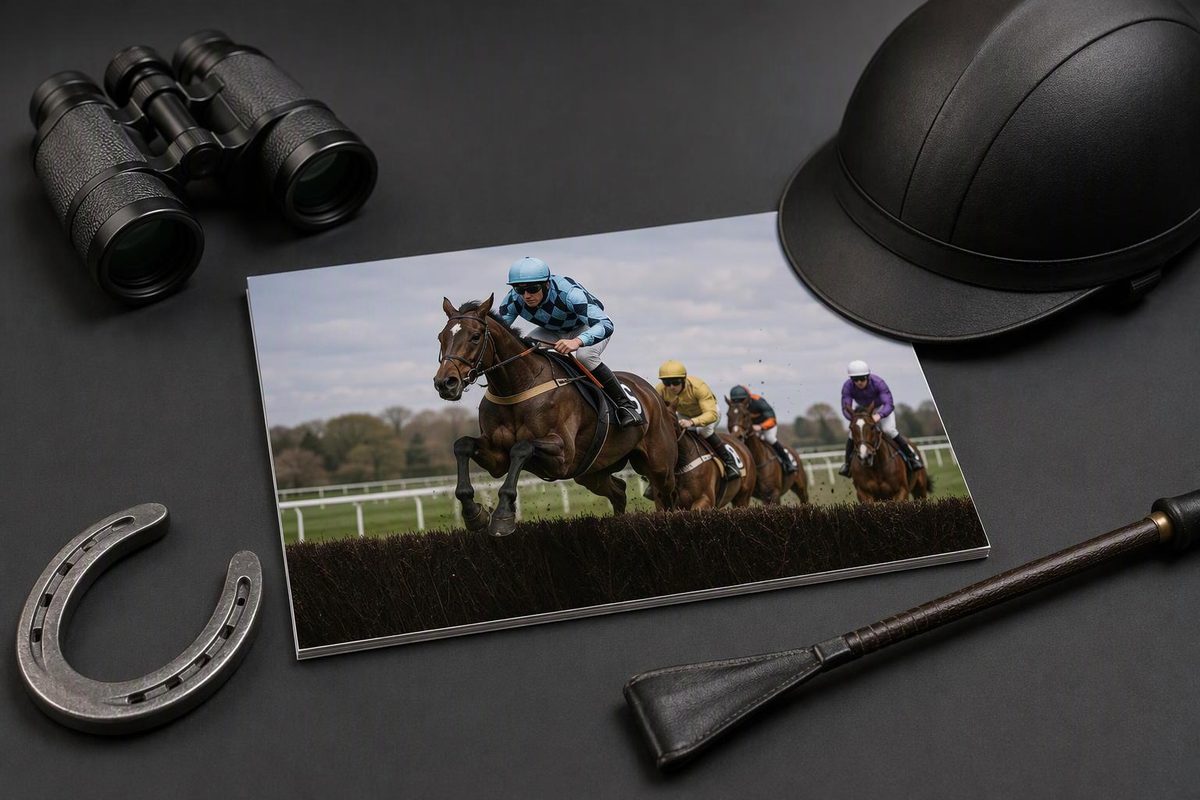
In British horse racing, a steeplechase—usually shortened to chase—is a Jump race over fences. It is not a hurdle race: hurdles are smaller obstacles, while chase fences present a more substantial jumping test. The Jockey Club says chases are generally run over two to four and a half miles, with obstacles that can include plain fences, open ditches and water jumps; it gives a minimum fence height of 4½ feet (The Jockey Club).
On a British racecard, look for Ch, Chase or Steeple Chase in the race description. H or Hur denotes a hurdle race, not a chase. Racing Post’s racecard abbreviations distinguish Ch, H/Hur and NHF.
Choose the labels shown on a racecard to see what each one says about the race and the horse’s form.
Chase Card Decoder
The default example reads Ch, Handicap and F.
Your Reading
Discipline: A chase over fences.
Race condition: Weights are allocated with reference to handicap ratings.
Form result: F records that the horse fell; it is a non-completion, not missing data.
Sources: Racing Post abbreviations, BHA race-type glossary and The Jockey Club form guide.
Chase, Hurdle and Bumper Are Different Tests
| Race type | What runners encounter | Common label |
|---|---|---|
| Steeplechase | Fences, potentially including plain fences, open ditches and water jumps | Ch, Chase, Steeple Chase |
| Hurdle | Smaller hurdles; The Jockey Club gives a minimum height of 3½ feet | H, Hur, Hurdle |
| National Hunt Flat race | No obstacles, despite being run under Jump rules | NHF, bumper |
That distinction changes how previous form should be read. A good hurdle result records racing ability, but it does not establish that the horse will jump chase fences efficiently. Conversely, a chase non-completion may contain information about the jumping test that a finishing position cannot show.
Terminology also varies by jurisdiction. In the United States, National Steeplechase Association cards distinguish hurdle races over National Fences from longer timber races. Its 2026 fall condition book, for example, includes two-mile hurdle races and timber races over trips of three miles or more (NSA 2026 condition book). Read the local race conditions rather than assuming every country divides jump races as Britain does.
Decode the Race Title Before the Form
A title such as “2m 4f Novices’ Handicap Chase” supplies four pieces of information:
- 2m 4f: the advertised distance—two miles and four furlongs.
- Novices’: an eligibility restriction linked to previous chase wins and the relevant season.
- Handicap: weights are allocated with reference to handicap ratings.
- Chase: the race is over fences.
In Britain, the BHA defines a novice chaser as a horse that had not won a chase before the end of the previous season. “Novice” therefore does not necessarily mean “never raced over fences” or even “never won a chase”; the individual race conditions still govern eligibility.
A beginners’ chase, by contrast, is restricted to horses that have never won a steeplechase. A hunter chase restricts both horses and riders under separate qualification rules (BHA glossary of race types).
Do not confuse a grade or class label with the obstacle type. The grade describes the race’s level; chase identifies the discipline. A chase can be either a handicap or a non-handicap, and a title can combine terms such as novices’, handicap and chase.
Read Distance and Going Together
Distance describes the trip, but the same nominal trip can impose a different test when the ground changes. British going descriptions run from Heavy through Soft, Good to Soft, Good, Good to Firm and Firm. More moisture generally means softer, slower ground (The Jockey Club’s going guide).
For a chaser, “won over 3m” is incomplete context. Check whether that result was over fences, what the going was, whether the course was broadly comparable and whether the horse finished strongly, weakened or failed to complete.
British cards may show a rounded traditional distance plus exact baseline yardage. The BHA introduced exact yardages alongside traditional descriptions rounded to the nearest half-furlong, and it notes that rail movements affect the distance covered (BHA distance methodology). Treat 2m 4f as the practical race label, not a guarantee that every running follows an identical path.
Separate Official Rating From Carried Weight
OR is the horse’s official rating—an assessment of ability—not the weight on its back. Weight is the assigned race-day load, usually displayed in stones and pounds on a British card.
In a handicap, ratings are used to allot weights so horses assessed at different levels can compete under adjusted loads. In a conditions race, weights can instead be determined by factors such as age, sex and previous wins (BHA glossary). Where a jockey’s claim applies, check the racecard for the allowance against the stated weight.
For the one-point-to-one-pound handicap framework, see how handicap ratings set the weights.
Treat Letters in Chase Form as Results
Jump form contains more non-numerical outcomes than Flat form. The oldest run is normally at the left of the string and the latest at the right.
| Symbol | Recorded outcome |
|---|---|
| F | Fell |
| U or UR | Unseated rider |
| P or PU | Pulled up |
| R | Refused |
| BD | Brought down |
| 1–9 | Finishing position |
| 0 | Finished outside the first nine |
These meanings are set out in The Jockey Club’s form-reading guide. The distinctions matter. F records a fall; BD says another runner brought the horse down; PU says the jockey stopped the horse before the finish. They are all non-completions, but they do not describe the same event.
A sequence such as 3F2-PU should be read chronologically, not reduced to “one second-place finish.” It records completed and uncompleted efforts, with the hyphen marking a season boundary. Open each result and check the race type, distance and going. For a non-completion, also check where and how the incident occurred.
Read a Steeplechase Racecard in Six Steps
- Confirm the code. Establish that the race is a chase rather than a hurdle or bumper.
- Read the eligibility and race type. Identify novice, beginner, hunter, handicap or conditions terms.
- Pair distance with going. Establish the physical test before interpreting finishing positions.
- Read recent chase form. Distinguish completions from falls, refusals, unseats and pull-ups.
- Compare OR with weight. Keep the ability assessment separate from the load assigned under today’s conditions.
- Add course-and-distance evidence. It supplies context, but does not prove that different ground, pace or opposition will produce the same result.
This order keeps the race conditions in front of the form figures. For other notation, use the horse-racing terms and racecard glossary or the line-by-line guide to reading a racecard.